
Confidence Is a Game Changer: Why Student Confidence Matters in School and Life

When students believe they matter, they show up differently.
They raise their hands.
They try something new.
They use their voice.
They recover from mistakes.
They contribute ideas.
They step into leadership.
Not arrogantly. Not from a belief that they are better than someone else. And not from the self-destructive belief that they aren't enough. They show up confidently.
At I AM Noticed, we believe confidence is one of the most important durable human skills students can develop. And perhaps most importantly, confidence isn't something students either have or don't have.
Confidence can grow.
It can be taught, practiced, strengthened, and reinforced through the experiences students have every day.
What Does Student Confidence Really Mean?
Confidence is sometimes misunderstood. We can mistake the loudest person in the room for the most confident. We can associate confidence with being outgoing, fearless, or certain.
But genuine confidence doesn't require any of those things.
Our definition begins somewhere much deeper:
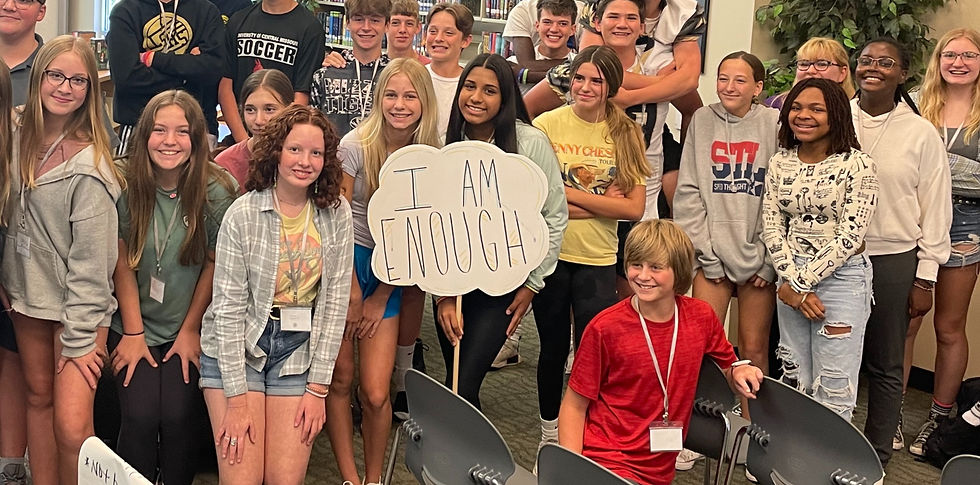
Confidence says, “I am enough.”
That is very different from arrogance, which says: “I am better than you.”
And it's equally different from self-destructive thinking, which says: “I am not enough.”
Healthy confidence lives between those two extremes.
A confident student can recognize their own value without diminishing someone else's.
They can be proud of something they've accomplished while celebrating another person's success.
They can make a mistake without deciding the mistake defines them.
They can enter a situation without knowing exactly what will happen and still trust themselves enough to try.
That kind of confidence is powerful.
Confidence Is a Skill, Not a Personality Type
Some students naturally appear more confident than others, but appearance can be deceiving, and confidence shouldn't be reserved for students who are naturally outspoken.
The quiet student can be confident.
The introverted student can be confident.
The student who feels nervous before speaking can still act confidently.
Confidence isn't simply the absence of uncertainty. It's developing enough self-worth and self-awareness to move forward even when uncertainty exists.
Like other durable human skills, confidence grows through intentional practice. Students need opportunities to recognize their strengths, practice positive self-talk, make choices, use their voices, take healthy risks, experience mistakes, and discover that they can recover.
Over time, those experiences become evidence.
I tried something difficult.
I made a mistake and survived it.
I contributed something valuable.
My voice mattered.
I can do hard things.
That is how confidence gets built.
Why Positive Self-Talk Matters
One of the most powerful influences on confidence is a conversation nobody else can hear. The one students have with themselves. Consider what happens when a student encounters something difficult and immediately thinks:
“I'm terrible at this.”
“Everyone else is better.”
“I can't do it.”

“I always mess things up.”
Those messages influence what happens next.
Positive self-talk doesn't mean pretending something is easy or repeating statements we don't believe. It means learning to communicate with ourselves in ways that are constructive, accurate, and kind.
“This is difficult, and I can keep trying.”
“I don't know how to do this yet.”
“I can ask for help.”
“One mistake doesn't define me.”
Students who develop healthier self-talk gain another tool for navigating challenges, learning, relationships, and life.
Confident Students Can Take Healthy Risks
Learning requires risk.
Answering a question when you aren't completely sure is a risk.
Trying out for a team is a risk.
Introducing yourself to someone new is a risk.
Sharing an original idea is a risk.
Applying for a leadership opportunity is a risk.
Standing up for something you believe in is a risk.
Confidence helps students become willing to take those healthy risks. Not because they know everything will work out perfectly, but because their sense of worth isn't entirely dependent on the outcome. That distinction matters enormously in school and beyond.
Confidence Builds Student Agency
Confidence and agency are closely connected.
Agency is the understanding that our choices, voices, and actions can influence what happens next. Students who develop agency don't see themselves merely as passive recipients of their circumstances. They begin to recognize:
I have choices.
I have a voice.
My actions matter.
That doesn't mean students control everything that happens to them. None of us do.
It means they can develop the ability to choose how they respond and how they contribute.
When confidence and agency grow together, students can become more active participants in their learning, relationships, leadership, and communities.
Confidence Is Foundational to Student Leadership
This is particularly important when we think about student leadership. Leadership isn't reserved for the loudest students, the elected students, or the students with titles.
Every student has influence.
Leadership can look like inviting someone into a group.
Speaking up when something isn't right.
Sharing an idea.
Recognizing goodness in another person.
Taking responsibility for a mistake.
Encouraging a teammate.
Helping create an environment where other people feel valued.
Students need confidence to exercise that influence positively. That's why student leadership development should include more than teaching students what leaders do. It should help them develop the durable human skills that allow them to become leaders.
Confidence Can Change the Way School Feels
There is another important dimension to this work. Developing confident students doesn't only prepare them for the future. It can positively influence the school they're attending right now.
Imagine a school filled with students who are increasingly able to say:
I am enough.
I can make mistakes.
I can use my voice.
I can recognize someone else's value without questioning my own.
I can positively influence this environment.
Those beliefs affect relationships. They affect participation. They affect leadership. They affect how students navigate challenges, and collectively, those daily experiences help shape positive school culture.
Teaching Confidence for School, Work, and Life
Long after graduation, students will continue encountering situations that require confidence.
They'll interview for jobs.
Join new teams.
Navigate relationships.
Receive feedback.
Experience failure.
Encounter uncertainty.
Make difficult decisions.
Lead other people.
And begin again.
Technical knowledge will matter in many of those moments, but so will the durable human belief underneath it:
I am enough to enter this moment, learn from it, and contribute to it.
That's why confidence is much more than a nice quality for students to develop. It's a durable human skill. And schools have an extraordinary opportunity to help students practice it.
At I AM Noticed, we believe intentionally developing durable human skills while giving students environments where they can practice those skills creates more connected, kind, and confident people. And those people help create more positive school cultures.
Confidence truly is a game changer.
Not because confident students believe they're better than everyone else, but because they learn something far more powerful:
They don't have to be. They are already enough.
If this resonates with you we'd love to hear from you and learn more about you and your perspective on education! You can get the conversation started here.


